
Droppings in the Attic: What They Are and What to Do
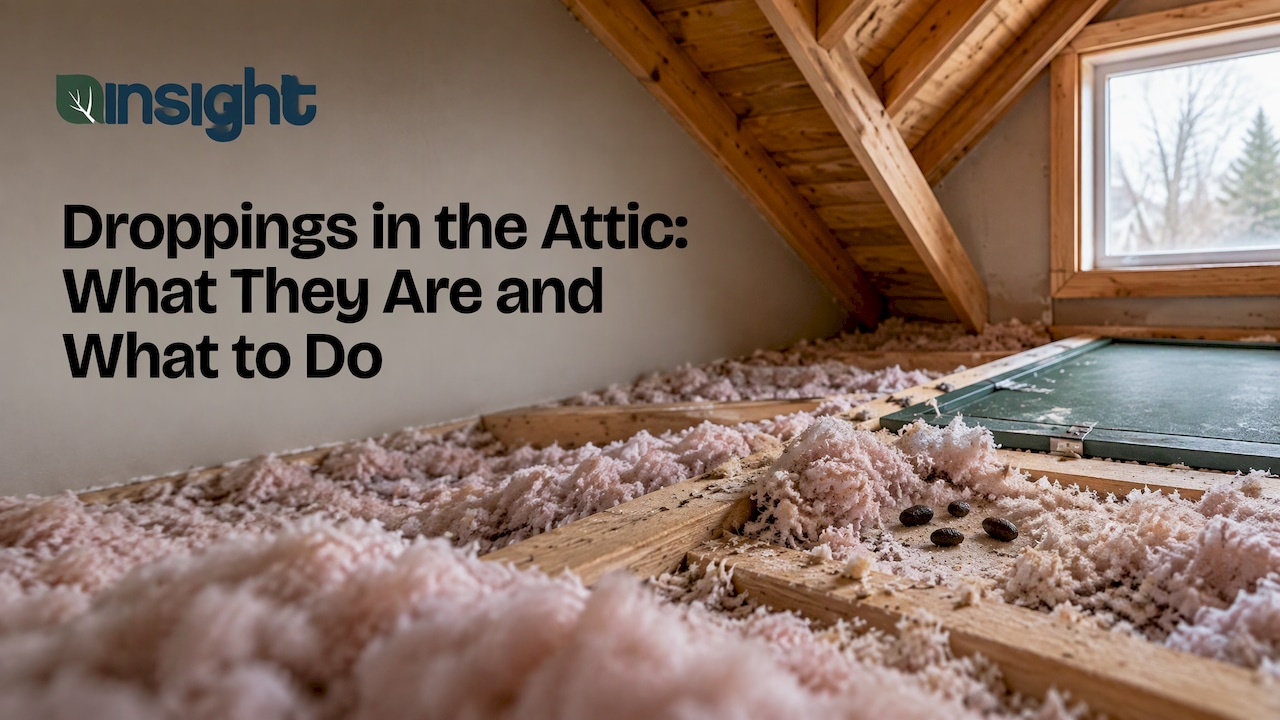
Small, dark pellets on your attic insulation or along the joists almost always mean rodents, and in most Canadian homes that means mice or rats. The droppings are the symptom. The cause is an opening somewhere on the outside of the house, and cleaning up without closing it only resets the clock. The lasting fix is a sequence: confirm what you are dealing with, clean up safely, remove the animals, then seal the entry points and keep bait stations working around the property through the seasons. Our rodent control service pairs exclusionary work with bait boxes around the property for exactly that reason.
TL;DR
- Mouse droppings are about 6 mm long with pointed ends. Rat droppings are 10 to 20 mm, so size is the fastest way to tell them apart.
- Never sweep or vacuum dry droppings. Dampen them with disinfectant first, wear gloves and an N95-level respirator, and double-bag the waste.
- Rodents carry real health risks, including hantavirus, which spreads when dried droppings and urine are stirred into the air.
- Droppings keep coming back unless the entry points are sealed. Any gap of 6 mm (1/4 inch) or more is big enough for a mouse.
- Rodent pressure rises in fall and winter, so prevention works best as a seasonal routine, not a one-off.
Table of Contents
- How to tell what the droppings are
- Why droppings in the attic are a health matter
- How to clean up droppings safely
- Cleaning up is not the same as solving it
- Why rodent prevention has to be seasonal
- What rodent control at your property looks like
- Seal the building: where animals get in
- What about the “5 day mouse rule”?
- When to call us
- Get rodents handled for good
- FAQ
- Sources
How to tell what the droppings are
Size and shape are your first clues. The Province of British Columbia gives house mouse droppings as about 6 mm long with pointed ends, roof rat droppings as 10 to 15 mm with pointed ends, and Norway rat droppings as 15 to 20 mm with rounded ends. Manitoba’s guideline describes mouse droppings as roughly the size and shape of a grain of rice, and rat droppings as cylindrical and sausage-shaped.
A quick field guide:
| What you see | Likely source |
|---|---|
| Rice-sized, pointed pellets, scattered | House mouse |
| 10 to 15 mm, pointed ends | Roof rat |
| 15 to 20 mm, rounded ends | Norway rat |
The same BC page notes that roof rats often nest in ceilings and attics, so large droppings in an attic are not unusual on the West Coast.
Fresh or old?
This matters because it tells you whether the problem is active. The Internet Center for Wildlife Damage Management notes that fresh droppings are shiny and often soft, while old ones are dry, lighter in colour and crumble easily. Manitoba’s guideline puts it in similar terms: black when fresh, lighter brown when old.
If you are buying a house and an inspector flagged droppings, this is the question to ask. Dry, crumbly pellets can be a past problem. Shiny, dark ones mean something was there recently.
Other signs that rodents are in the attic
Droppings rarely appear alone. Health Canada lists scratching and scampering sounds at night, gnawing, damaged food packaging, urine, burrows around foundations and tracks on dusty surfaces as signs of an infestation. In an attic, also look for flattened or tunnelled insulation, shredded nesting material and chew marks on wood or wiring. Gnawed wiring is a fire risk, which is one more reason not to leave the problem alone.
Why droppings in the attic are a health matter
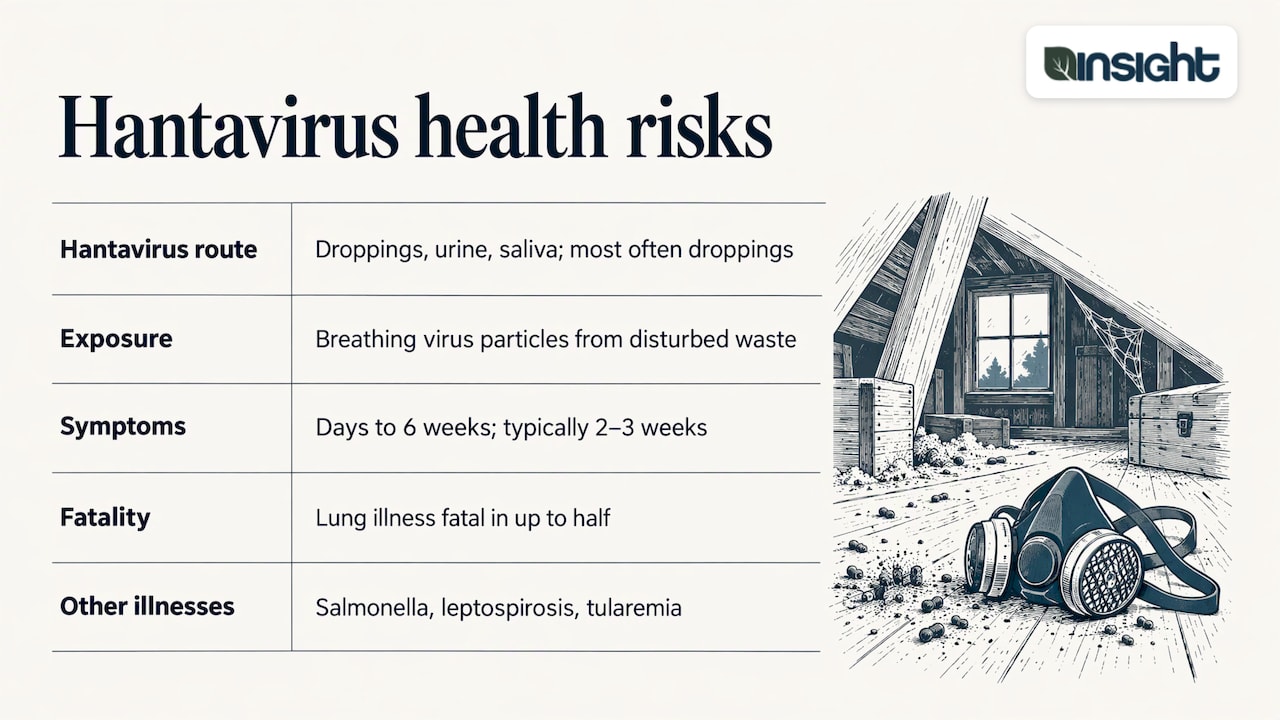
Rodent waste is not just unpleasant. The Public Health Agency of Canada says hantaviruses are spread by rodents most often through droppings, urine and saliva, and people can be infected by breathing in virus particles when waste is disturbed. In North America the deer mouse, white-footed mouse and red-backed vole are among the carriers, and they are widespread in parts of Canada.
Hantavirus illness is rare, but serious. Saskatchewan’s health ministry reports that symptoms begin within days to six weeks, typically two to three weeks after exposure, and the lung illness it causes can be fatal in up to half of cases. Southwestern Public Health also lists salmonella, leptospirosis and tularemia among illnesses rodents can spread, and says proper cleanup and keeping rodents out lower the risk.
An attic is a confined, poorly ventilated space where dust hangs in the air. That is the worst setting for disturbing dried droppings. If you or anyone in your household develops flu-like symptoms or breathing trouble within weeks of cleaning rodent waste, see a doctor and mention the exposure.
How to clean up droppings safely
For a small amount of droppings, follow the Public Health Agency of Canada’s steps:
- Ventilate first. Alberta Health Services advises airing the area for 30 minutes before you start. Keep children and pets out.
- Gear up. Wear rubber or plastic gloves and, in a confined space like an attic, an N95-level respirator. Goggles are a good addition.
- Do not sweep or vacuum. Both raise dust. Health Canada warns that dry sweeping or vacuuming can put dust into the air and cause illness.
- Wet everything down. Spray the droppings and nearby material with an approved disinfectant, or a mix of 1 part bleach to 9 parts water, and let it soak for 10 minutes, per PHAC’s guidance.
- Wipe up. Use paper towels or a wet mop, not a dry broom.
- Double-bag and dispose. Put waste, towels and gloves in a sealed bag, then in a second one.
- Wash your hands thoroughly, and wash exposed clothing separately.
When to leave it alone
The same PHAC page says that for heavily infested and contaminated areas, you should consider hiring a professional cleaning company. Wet insulation soaked with urine, thick layers of droppings, nests and dead animals all fall into that category. Do not climb into the space and start pulling insulation out. If the contamination is widespread, get the rodents dealt with first, then have the area cleaned.
Tenants should also know that in Alberta, landlords must by law keep a home pest-free. Check the tenancy rules in your own province before you pay for treatment yourself.
Cleaning up is not the same as solving it
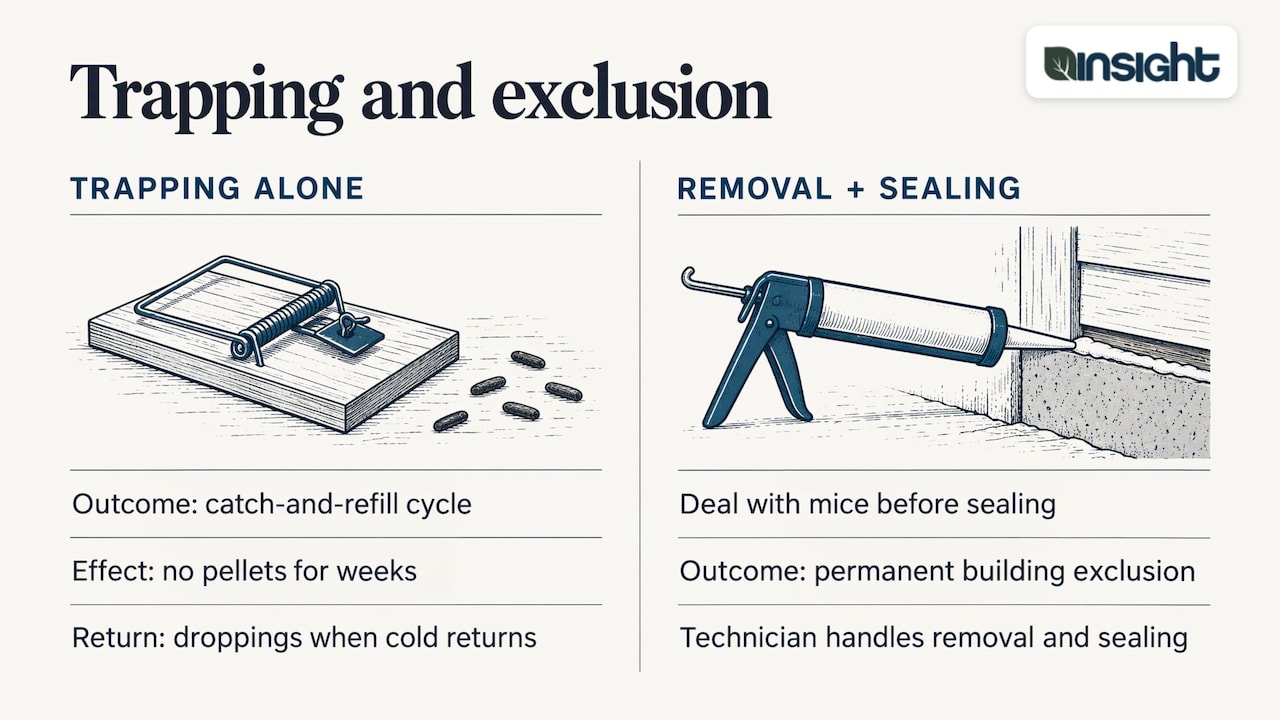
Here is the pattern many homeowners fall into: find droppings, clean, set a few traps, and see no more pellets for a couple of weeks. The problem seems solved. Then the cold returns and so do the droppings.
Trapping alone cannot win against an unlimited supply of mice outdoors. Homeowner.ca’s fall mouse-proofing guide makes the point that trapping without exclusion is a catch-and-refill programme, while sealing the building is the permanent fix. It also stresses order: sealing interior openings while mice are still inside can trap them in wall voids, so the animals have to be dealt with before the last gaps are closed.
That sequence is where professional help earns its place. Getting it wrong means mice dying inside walls or a sealed house with the colony still in it. A technician who handles both the removal and the sealing, in the right order, takes that judgment off your hands.
Why rodent prevention has to be seasonal
Rodents follow the weather, and the calendar for your attic follows it too.
- Fall: As temperatures drop, mice look for warmth and food. Alberta Health Services says house mice enter homes in fall and winter through cracks as small as 1 cm. A mouse needs a gap roughly the width of a finger. This is the season to seal and to put bait stations in place before activity peaks.
- Winter: Warm attics and wall voids become shelter, and activity continues out of sight. Scratching at night and fresh droppings are the typical signs.
- Spring: Rodents breed and nest, and damage to insulation and wiring shows up. It is a good time to check that seals have held and to look for new gaps caused by freeze and thaw.
- Summer: Outdoor food, garbage and clutter keep populations strong around the property, so they are ready to move back in at the first cool nights.
A single treatment handles the animals you have today. A seasonal approach handles the ones arriving next month. That is the idea behind our Quarterly Protection plan, which brings quarterly preventive visits so the property is checked as conditions change, with unlimited follow-up service calls included in our service.
What rodent control at your property looks like
Our rodent control combines two things that work together:
- Exclusionary work. Finding and sealing the openings rodents use to get into the home. This is the part that stops droppings from coming back.
- Bait boxes around the property. Stations placed around the outside of the home intercept rodents before they reach the structure.
It starts with a property inspection, where we look for how rodents are getting in and where they are active. Our technicians are certified, and our approach pays attention to household and pet safety. We are also QualityPro accredited, which reflects the way we hire, train and put safety first.
If you want to read more on how rodents move through a house, our guide to crawl space rodent control covers finding, sealing and clearing mice and rats, and our house mouse guide shows what we look for.
Seal the building: where animals get in
Exclusion is the permanent part of the fix, and the government guidance is specific about it. The Province of British Columbia advises sealing every opening larger than 6 mm (1/4 inch) with steel wool, caulking and heavy 1/4-inch wire mesh, including over dryer and attic vents. Health Canada recommends covering dryer vents, attic vents and soffits with fine mesh metal screening, patching foundation cracks and stuffing steel wool around pipes before caulking.
Check these spots from the outside:
- Roof vents, gable vents and soffits
- Gaps where pipes, cables and vents pass through walls
- Chimney tops, which BC advises capping
- Foundation cracks and gaps beneath doors
- Branches touching the roof or hanging over the eaves, which give rodents a bridge
Metal stops teeth and sealant holds the metal in place, so plain foam or paper filler will not last. Vents also need to keep airflow working, so before you screen or change any, review the basics of attic vent requirements.
Habits that keep rodents away
Health Canada and BC also list yard and household measures:
- Store firewood at least 30 cm off the ground and away from the house.
- Keep bushes trimmed 15 to 20 cm above ground.
- Use lidded garbage containers and keep dry food and pet food in metal or glass containers.
- Remove clutter and water sources.
- Clean urine stains and rub marks, since rodents are drawn to the smells other rodents leave behind.
These habits support sealing and baiting. They do not replace them.
What about the “5 day mouse rule”?
You may see this phrase online. It is a rule of thumb about how many days without activity means the mice are gone, and it is not an official standard. The idea is useful in one way: a quiet few days proves little. Mice can avoid traps, and rodent activity can pick up again after a quiet spell. A reasonable approach is to watch for new droppings, gnawing and noises over several weeks, and to treat any new sign as a sign the entry point is still open.
When to call us
Make the call if any of these apply:
- You see fresh, shiny droppings, or droppings keep returning after cleanup.
- You hear scratching in the ceiling or walls at night.
- There is a lot of contaminated insulation or nesting material.
- You are buying or selling a home and an inspection flagged rodent activity.
- You have cleaned up once already and the signs came back.
With heavy infestations, Alberta Health advises hiring a certified pest control professional who does a full inside-and-outside inspection to find and block entry points. That is how we approach it.
Get rodents handled for good
We help homeowners across Canada deal with mice and rats through inspection, exclusionary work and bait boxes around the property, and we offer ongoing protection through seasonal visits. Request a quote by phone or online through our rodent control page.

If you want the property protected year-round, ask about Quarterly Protection, which brings quarterly preventive visits. You can see everything we cover on our pest control services page.
FAQ
How can I tell mouse droppings from rat droppings in my attic?
Measure them. Mouse droppings are about 6 mm long with pointed ends, similar to a grain of rice. Rat droppings run 10 to 20 mm, with rounded ends in Norway rats and pointed ends in roof rats. Shiny, dark pellets are recent, and dry, pale, crumbly ones are older.
Is it dangerous to be around mouse droppings in the attic?
It can be, mainly if dried droppings are disturbed and the dust is breathed in. Public health agencies link rodent waste to hantavirus and other illnesses. Wear gloves and an N95-level respirator, wet the droppings before you touch them, and never sweep or vacuum them dry.
Can I use bleach to clean up droppings?
Yes. The Public Health Agency of Canada advises spraying droppings with an approved disinfectant, or 1 part bleach to 9 parts water, and letting it soak for 10 minutes. Then wipe with paper towels or a wet mop and double-bag everything. Do not mix bleach with other cleaners.
Why do droppings keep coming back after I clean?
Because the entry points are still open. Rodents follow scent trails left by earlier visitors, and a mouse can squeeze through a gap about 1 cm wide. Sealing the openings and keeping bait stations around the property addresses the cause, not just the mess.
When should I get professional help?
Call a professional when droppings are widespread, insulation is soaked or soiled, you can hear animals at night, or signs return after cleanup. Health guidance suggests a professional cleaning company for heavily contaminated areas, and a certified pest control provider for the inspection and entry-point sealing.
Sources
- Recommendations for Cleaning Areas, Manitoba
- Inspection, Internet Center for Wildlife Damage Management
- Rats and mice, Health Canada
- Hantavirus: Spread, prevention and risks, Public Health Agency of Canada
- Hantavirus, Government of Saskatchewan
- Rodents, Southwestern Public Health
- The House Mouse, Alberta Health Services
- Fall Mouse-Proofing Explained, Homeowner.ca
- Attic vent requirements