
Yellow Jacket Exterminator: When to Call and What to Expect
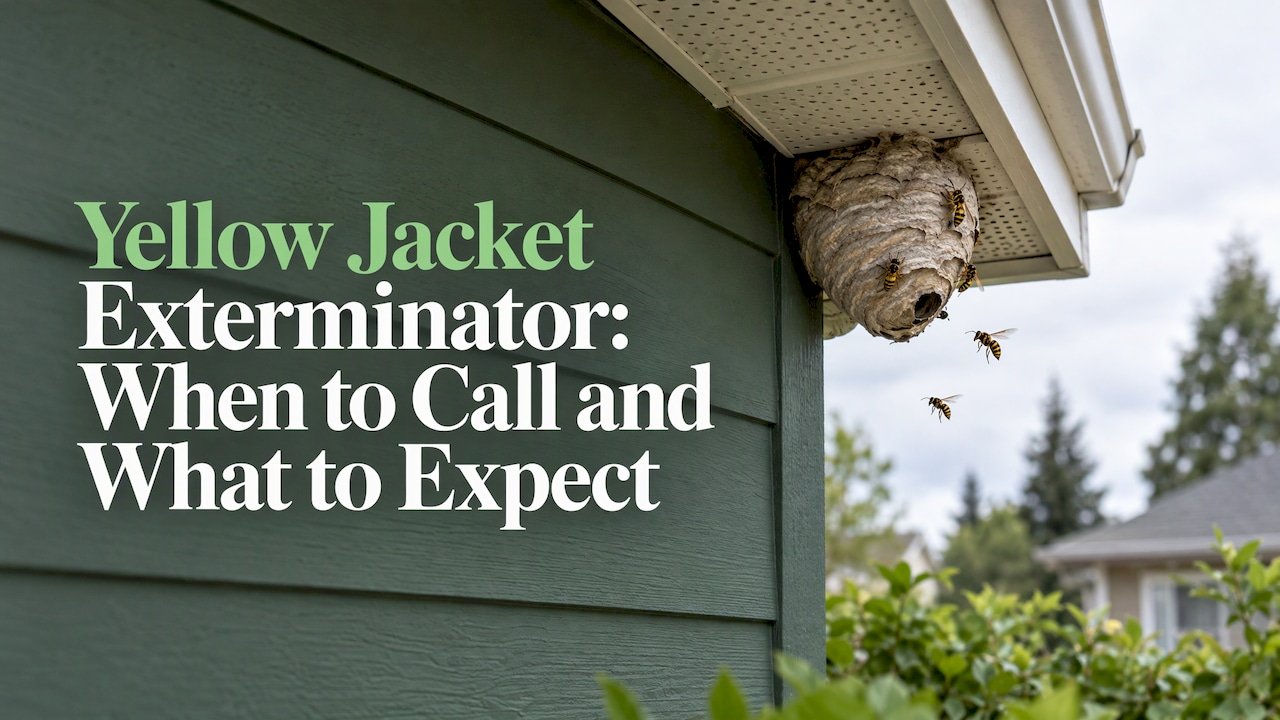
If yellow jackets are nesting in your lawn, wall or soffit, the safest move is to have a trained technician deal with the nest. The risk comes from the nest itself: you can’t see how big it is, you can’t tell where it ends, and a disturbed colony stings in numbers. Our wasp control service is built for exactly this. Our certified technicians treat nests with attention to household and pet safety.
Below is what you need to decide: how to recognize yellow jackets, when a nest has to go, what official Canadian guidance says about removal, and when it is time to call.
TL;DR
-
Yellow jackets are medium-sized black-and-yellow wasps. Health Canada names German yellow jackets as the most aggressive social species.
-
Nests in wall voids, attics, along foundations, underground or in hard-to-reach spots are the ones to leave to a professional.
-
Never block the opening of a wall nest, and never pour fuel into a ground nest.
-
Late summer and early fall are the peak for stings, because colonies are at full size.
-
Reach out early if anyone in your home has a sting allergy.
Table of Contents
How to recognize a yellow jacket
Health Canada describes yellow jackets and hornets as medium-sized wasps, 10 to 25 mm long, with black and yellow (or white) bands on the abdomen. The stinger is hollow and injects venom. Unlike honey bees, yellow jackets can sting more than once, according to The Canadian Encyclopedia.
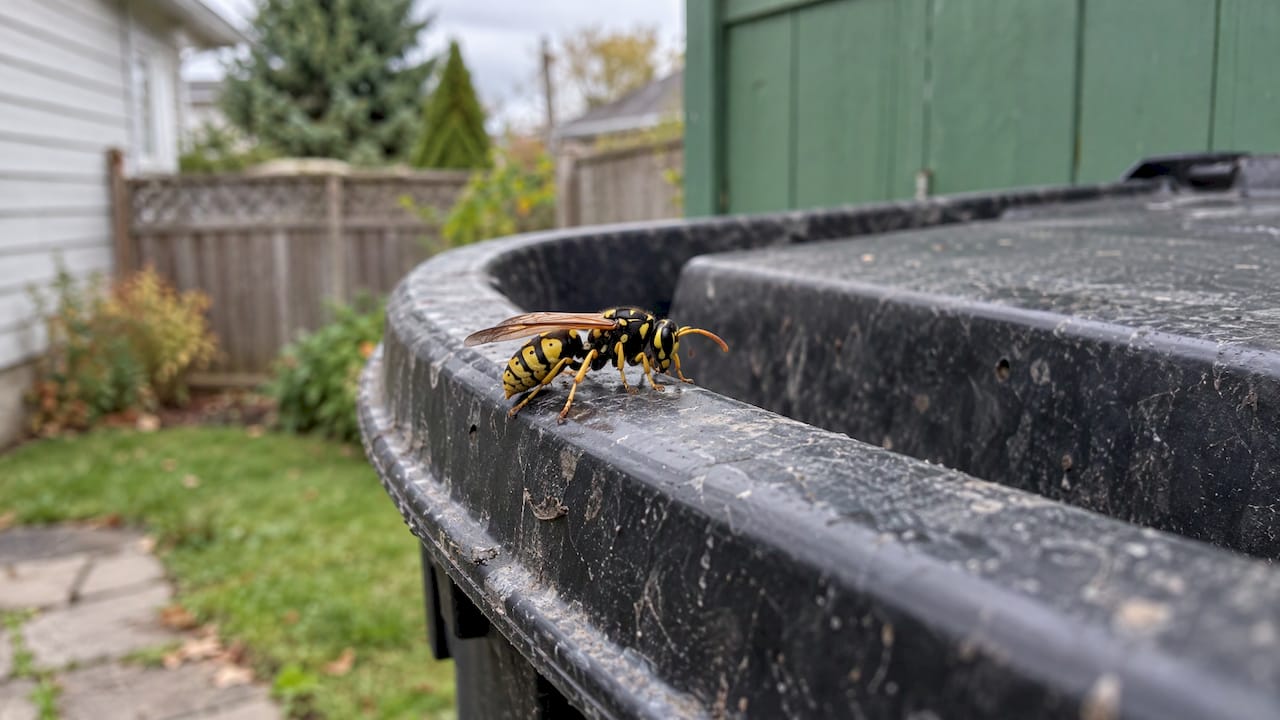
They live across Canada except the far north. The same source says the German yellowjacket is especially common in Ontario and Quebec, while other species are the main nuisance in the East and West.
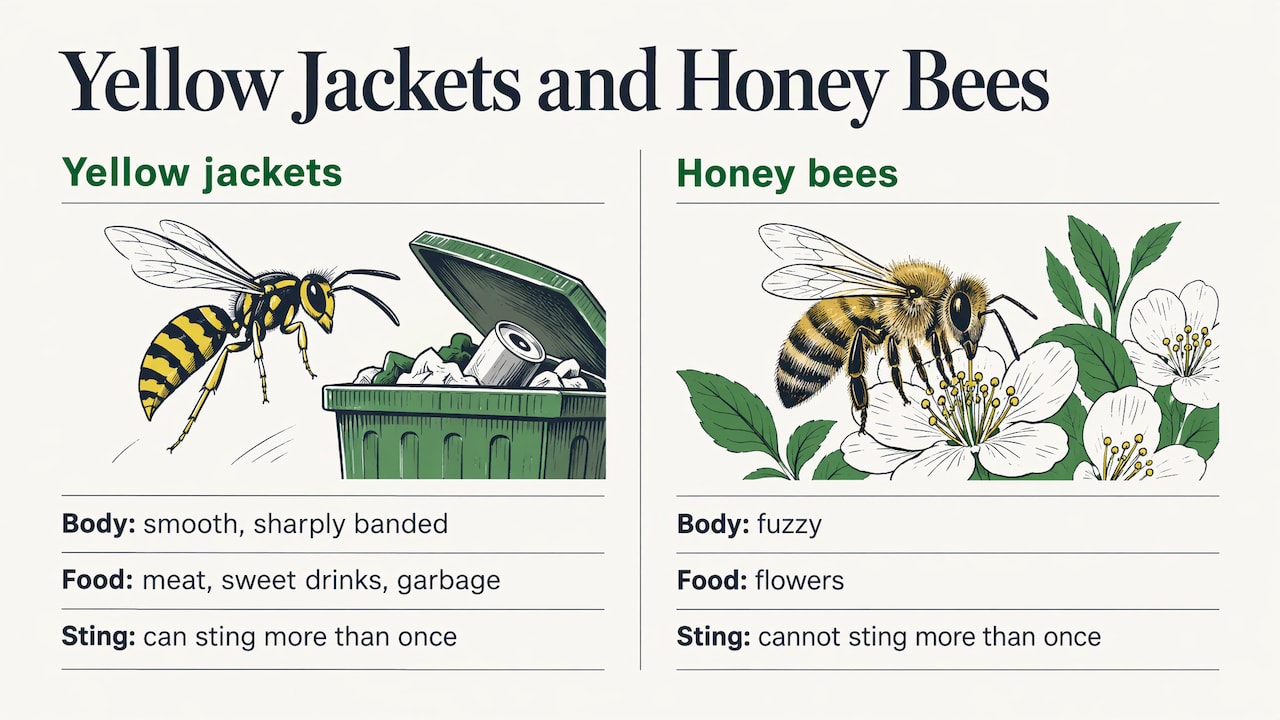
A quick way to tell them from bees: yellow jackets are smooth and sharply banded rather than fuzzy, and they hover around meat, sweet drinks and garbage rather than flowers.
Where the nest is, and why it matters
Queens build nests underground, in aerial paper nests, or in hollow openings in buildings such as soffits and the space under siding. That hidden placement is the main danger. People are often stung when they step on a ground nest while mowing.
Clues that a nest is close:
-
A steady line of wasps flying to and from one small hole in the lawn, a garden bed or the base of a wall.
-
Wasps entering a gap in siding, a soffit or a vent.
-
A grey, papery ball hanging under an eave or in a shrub.
-
Scratching or buzzing inside a wall.
Stand well back to watch, and watch near dusk, when most of the colony is home. Do not poke, hose or cover the hole.
When a nest has to be removed
Official guidance is not uniform, and it helps to know the reasoning.
Health Canada advises tolerating small populations. If a nest is not a health hazard, it can be left until November or December, when it has been abandoned and can be removed with little risk. Nests are not reused the following year, and only new queens survive winter, as the City of St. Albert notes.
But a nest by your front door, in your wall or next to a play area is a hazard, and for those the timing changes:
-
Early in the season: the City of Edmonton says that for a nest in an inconvenient spot, removing it earlier is best because there are fewer wasps to deal with than in the fall.
-
Late summer: British Columbia’s guidance says larger nests are often best left until the end of the season, when the wasps die. That only works if nobody needs to walk, mow or play near the nest. In practice, many nests sit exactly where people live.
Why the late summer matters: colonies peak in size just as natural prey declines, so wasps turn to food and drinks around people. An entomologist quoted by Wisconsin Public Radio explains this pattern. The City of St. Albert likewise says yellowjackets are more aggressive around people at the end of summer.
What the do-it-yourself route involves
Government pages describe the steps in detail, and they show how much can go wrong. British Columbia’s protocol asks for:
-
Head-to-toe protective clothing: boots with pants sealed over them, gloves with sleeves sealed over the gloves, and a screened hat veil tied at the neck.
-
An extra under-layer, because stingers can reach through a single layer of cloth.
-
Approaching in the evening or at night.
-
Cutting the nest’s attachment with a long-handled tool into a heavy bag or lidded box, then deep-freezing it, or treating it with insecticide according to the label.
Health Canada adds that insecticide should be applied after nightfall, with a red-filter flashlight, using a product with a PCP number (the registration number on approved pesticides in Canada) and following the label.
These are the points where it goes wrong:
-
Aerosol sprays on hidden nests. An entomologist at the University of Wisconsin explains that pyrethroid sprays can act as a repellent, pushing wasps out of a wall void and into the house. That source is from the US, but the behaviour is the same.
-
Fuel in the ground. BC warns never to pour gas or kerosene into an underground nest because it poisons the soil.
-
Poison baits. BC says these are dangerous to children, pets and beneficial insects.
-
Blocking the entrance. For wall nests, BC says never to seal the opening, because wasps can chew through wood or follow wiring into the interior.
-
One alarm, many stings. A stung yellow jacket releases an attack pheromone that excites nearby wasps to sting too.
When to call a professional
British Columbia’s Ministry of Environment advises considering a pest management professional for very large nests, hard-to-reach locations and wall-void nests. The City of St. Albert adds that if you are not comfortable removing a nest yourself, or you have allergies, contacting a pest management company is best.
In plain terms, call when:
-
The nest is in a wall, attic, soffit, crawl space or along the foundation.
-
The nest is underground and you can’t safely treat it at dusk.
-
It is above ladder height or hard to reach.
-
Children, pets or anyone with a sting allergy use the area.
-
You have already sprayed and wasps are still coming.
Health Canada reports that several thousand people are stung each year, with rare deaths from severe allergic reactions. See a doctor, or call emergency services, for unusual swelling, itching, dizziness or shortness of breath after a sting. Most people recover from pain and itching within a day or two, per The Canadian Encyclopedia.
What a professional visit looks like
With Insight, a certified technician treats the nest and the areas around it, with household and pet safety in mind. We hold QualityPro Accreditation, which reflects how we hire, train and run safety. Our service is backed by follow-up, and the unlimited follow-up service calls are part of what we offer.
We also remove wasp nests, which matters for the second thing readers ask about: once wasps are gone, the empty nest and its entry points still need attention. BC advises that once a wall nest is definitely vacant, openings should be caulked or repaired.
Why a pro is the better answer to a yellow jacket nest
The main reasons come from the evidence above rather than from a sales pitch:
-
The nest is usually hidden, so size and location are guesses until someone trained finds it.
-
The safe method needs full protective gear, night work and the right registered product.
-
The common home fixes (aerosols, fuel, sealing the hole) are the ones officials warn against.
-
A mistake costs stings, and for allergic people the risk is serious.
If you want the nest handled, request a wasp control quote with us. Tell us where the activity is and when you see it, and whether children, pets or allergies are in the household.
If yellow jackets are one of several pests you deal with, our quarterly protection plan brings preventive visits through the season, and our full list of services covers ants, spiders, rodents, mosquitoes, ticks and more.
Keeping yellow jackets from coming back
Nests are not reused, but new queens look for sites each spring. The City of St. Albert’s prevention advice is practical:
-
Remove log and leaf piles.
-
Clean up after outdoor cooking and keep food covered.
-
Cover or remove standing water.
-
Keep garbage in sealed containers.
-
Consider planting spearmint, thyme, lemongrass or wormwood.
In spring, walk the property for small nests under eaves, in sheds and at the base of walls. Queens are most often seen in May, and worker numbers are large from July to October, according to Raid Canada. Early removal means fewer wasps.
FAQ
Do I need to remove a yellow jacket nest?
Not always. Health Canada advises tolerating small populations when a nest is no hazard. If it is near a door, play area or walkway, or inside a wall, removal is the safer course, and a professional is the right person for wall and hard-to-reach nests.
When is the best time to remove a nest?
Early in the season, while it is small, there are fewer wasps to deal with. Large nests are riskier to approach in late summer. Evening or night is the time to treat a nest, since most wasps are inside.
Can I just block the hole or spray it?
No. BC’s guidance says never to block a wall opening, because wasps can chew through or follow wiring indoors. Sprays on hidden nests can drive wasps out toward you, and fuel poisons soil.
Are yellow jackets active every year in the same nest?
No. Nests are not reused. Only new queens overwinter, and each starts a new colony in spring.